In LINUX, hashed passwords are stored in /etc/shadow
User administration: /etc/passwd /etc/group
On WINDOWS
It is much more complicated and consists of many modules. There are also different authentication processes, such as Kerberos. In addition, the Local Security Authority (LSA) is a protected subsystem that authenticates users and logs them on to the local computer
The security subsystem keeps track of the security policies and accounts that reside on a computer system. In the case of a Domain Controller, these policies and accounts apply to the domain where the Domain Controller is located. These policies and accounts are stored in Active Directory. In addition, the LSA subsystem provides services for checking access to objects.
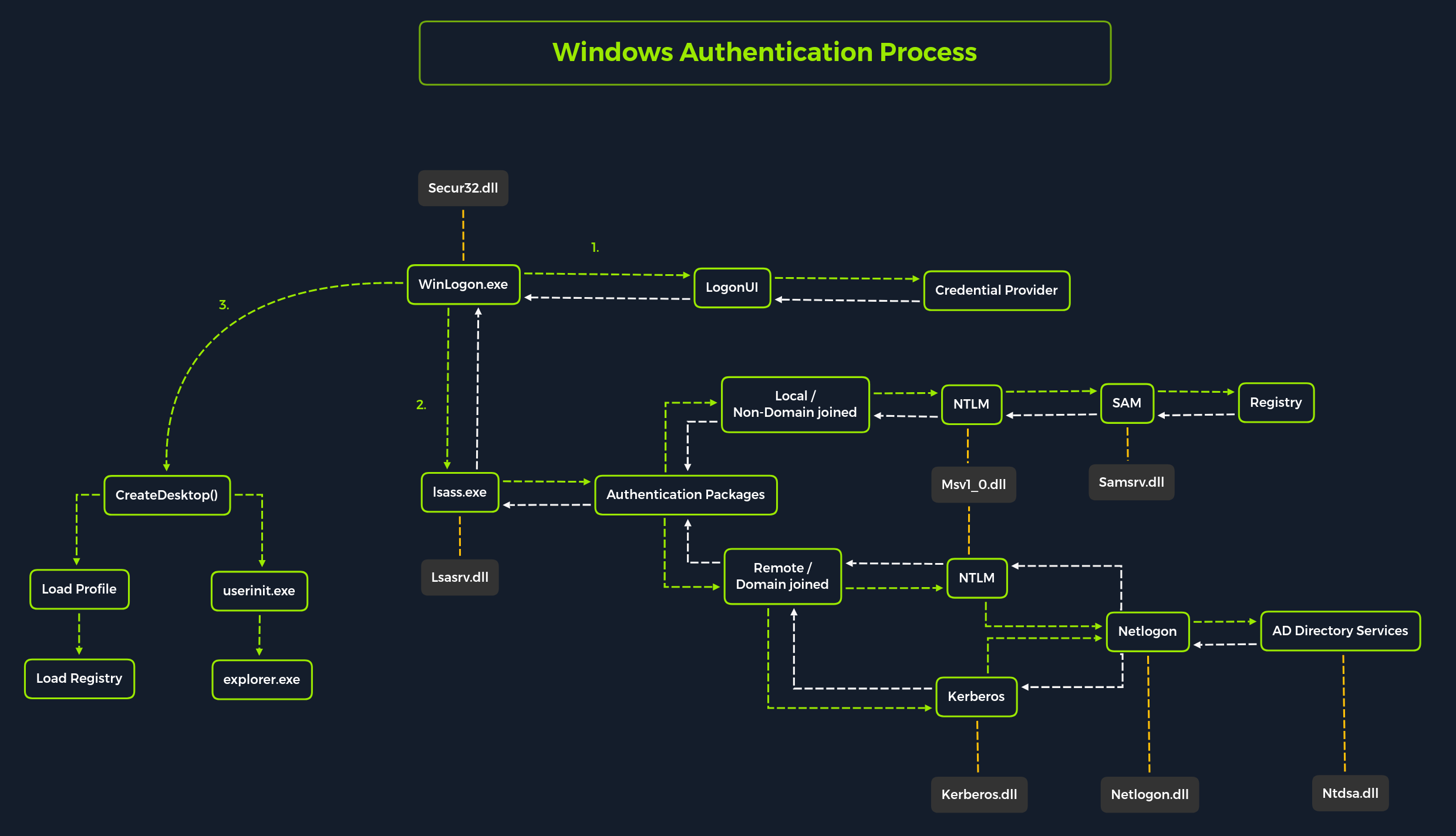
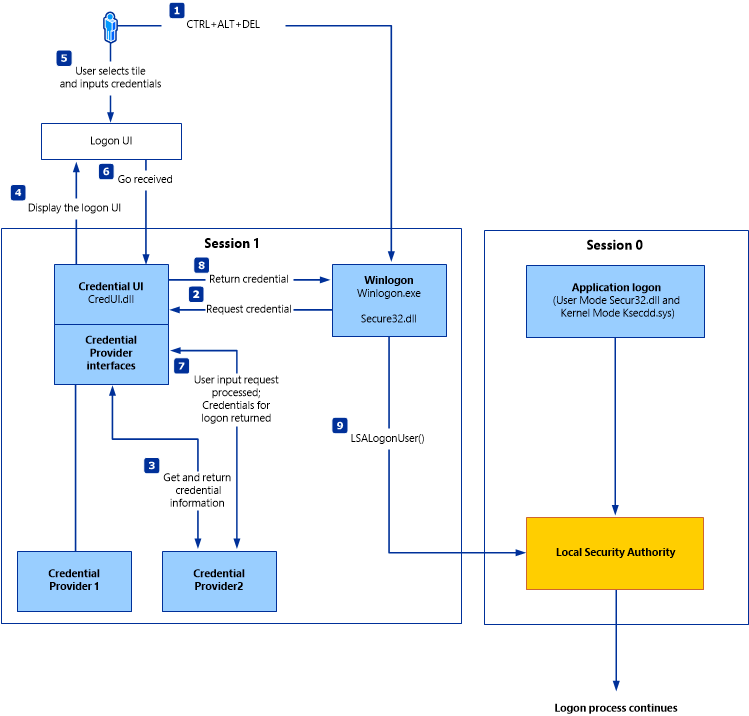
Local interactive logon is performed through interaction between the logon process (WinLogon), the logon user interface process (LogonUI), credential providers, LSASS, one or more authentication packages, and SAM or Active Directory
For example, the Msv1_0.dll authentication package is used for interactive, non-domain-joined logons
LSASS
It is a collection of many modules and has access to all authentication processes, and can be found at %SystemRoot%\System32\Lsass.exe
This service is responsible for the local system security policy, user authentication, and sending security audit logs to the Event log
Authentication packages: Description
Lsasrv.dll: The LSA Server service enforces security policies and acts as the security package manager for the LSA. The LSA contains the Negotiate function, which selects the NTLM or Kerberos protocol after determining which protocol should succeed.
Msv1_0.dll: Authentication package for local machine logons that do not require custom authentication.
Samsrv.dll: The Security Accounts Manager (SAM) stores local security accounts, enforces locally stored policies, and supports the APIs.
Kerberos.dll: Security package loaded by the LSA for Kerberos-based authentication on a machine.
Netlogon.dll: Network logon service.
Ntdsa.dll: This library is used to create new records and folders in the Windows registry.
SAM
It is a database file on Windows operating systems that stores user passwords. It can be used to authenticate local and remote users. SAM uses cryptographic measures to prevent unauthenticated users from accessing the system
User passwords are stored in hashed format in a registry structure as either an LM hash or an NTLM hash. This file is located at %SystemRoot%/system32/config/SAM and is mounted at HKLM/SAM. SYSTEM-level permissions are required to view it.
Credential Manager
Credential Manager is a feature built into all Windows operating systems that allows users to save the credentials they use to access various network resources and websites. Saved credentials are stored according to user profiles in each user's Credential Locker
It is very common to encounter network environments in which Windows systems are joined to a Windows domain. This is common because it makes it easier for administrators to manage all systems owned by their respective organizations (centralized management). In these cases, Windows systems will send all logon requests to Domain Controllers belonging to the same Active Directory forest